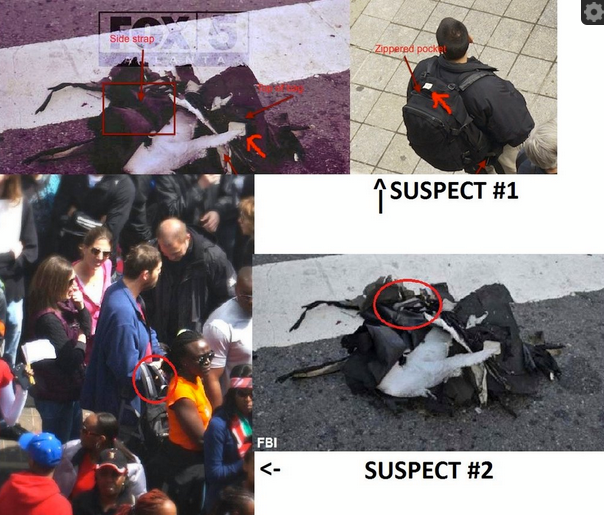
This blood from this scene is dark in color quickly coagulates, there is a big difference in the pictures from the Boston blast

here is a popular Boston scene foto..


A top level Republican IT consultant who was set to testify in a case alleging GOP election tampering in Ohio died in a plane crash late Friday night.................READ THE REST HERE
Michael Connell -- founder of Ohio-based New Media Communications, which created campaign Web sites for George W. Bush and John McCain -- died instantly after his single-prop, private aircraft smashed into a vacant home in suburban Lake Township, Ohio.
"The plane was attempting to land around 6 p.m. Friday at Akron-Canton Airport when it crashed about three miles short of the runway," reports the Akron Beacon Journal.
Connell's exploits as a top GOP IT 'guru' have been well documented by RAW STORY's investigative team.
The interest in Mike Connell stems from his association with a firm called GovTech, which he had spun off from his own New Media Communications under his wife Heather Connell’s name. GovTech was hired by Ohio Secretary of State Kenneth Blackwell to set up an official election website at election.sos.state.oh.us to presented the 2004 presidential returns as they came in.
Connell is a long-time GOP operative, whose New Media Communications provided web services for the Bush-Cheney ’04 campaign, the US Chamber of Commerce, the Republican National Committee and many Republican candidates. This in itself might have raised questions about his involvement in creating Ohio’s official state election website
Finding Solutions
We must find in-depth, innovative solutions to our health care crisis. Reform can’t –and won’t- come overnight, but by working together I’m confident we can make great strides in health care reform.
Under my plan:
• Insurance companies will compete for business- which will bring down costs- but they will also be required to meet minimum standards for coverage, including preventive care. (don't they already compete...or is that an illusion...the same illusion of competition youll see if this bill is passed....denials, rate hikes, red tape...its a damn business...they need to make a profit...off of your illness)• No one would be denied coverage or face higher costs because of their past medical history or for going to the doctor more often.
• A technology based medical records system would streamline the health care application process.(they just want to track your info better so they can deny you, this is kinda bizzaar...im curious about this records system)
• More people who can’t afford health insurance to be immediately covered through Medicaid, Medicare and the Children’s Health Insurance Program. (until you get a job then employers control your health insurance, this plan really sucks...and to think I had hope in Baucus)In Montana, we know how to solve problems, how to build our communities, how to take care of each other. If a neighbor is sick, we bring soup, medicine and comfort. Now, our health care system is ailing. And the time has come to find the cure.
Together we can make this happen.


On the occasion of Barack Obama's rollout of his health policy team, and given that, according to a couple of pieces of paper I have around here somewhere, I'm a doctor, this seems a good time to spout off -- yet again -- on the state of health care in the US. What it really boils down to is this: we need to reduce cost and raise quality. As long as the discussion is only about paperwork, ie, single payer vs current insurers, electronic vs paper records; and as long as the only real efforts to control costs are in reducing payments to providers, we'll be getting nowhere. As usual.
I've written about why I favor single-payer, and have acknowledged that among physicians I'm in a distinct minority. I've said pretty much all I know about that aspect of it. Moreover: as controversial as it is, it's really only nibbling around the edges. Solutions --REAL solutions -- will come from fundamentally changing the nature of care itself, and how we provide it. And if you think addressing insurance is complicated and daunting, you ain't seen nothin'
Being a Milton Friedman capitalist, DrRich is all in favor of having plenty of robust, profit-seeking entities knocking about within the American economy, even within the healthcare sector of the economy. In principle, he is even in favor of giving for-profit health insurance companies a chance to prove that they can deliver quality healthcare with greater efficiency and better outcomes than certain non-profit entities, such as, say, the government. If the insurance companies can give us good healthcare at lower cost,...............................read more here
Breast cancer is the leading cause of death among American women between the ages of 44 and 55. Dr. Gofinan, in his book, Preventing Breast Cancer, cites this startling statistic along with an in-depth look at mammographic screening, an early-detection practice that agencies like the American Cancer Society recommend to women of all age groups. According to most health experts, catching a tumor in its early stages increases a woman's chances of survival by at least 17 percent.
The most common method for early detection is mammography. A mammogram is an X-ray picture of your breast that can reveal tumor growths otherwise undetectable in a physical exam. Like all x-rays, mammograms use doses of ionizing radiation to create this image. Radiologists then analyze the image for any abnormal growths. Despite continuous improvements and innovations, mammography has garnered a sizable opposition in the medical community because of an error rate that is still high and the amount of harmful radiation used in the procedure.
Effectiveness of Mammography
Is mammography an effective tool for detecting tumors? Some critics say no. In a Swedish study of 60,000 women, 70 percent of the mammographically detected tumors weren't tumors at all. These "false positives" aren't just financial and emotional strains, they may also lead to many unnecessary and invasive biopsies. In fact, 70 to 80 percent of all positive mammograms do not, upon biopsy, show any presence of cancer.
At the same time, mammograms also have a high rate of missed tumors, or "false negatives." Dr. Samuel S. Epstein, in his book, The Politics Of Cancer, claims that in women ages 40 to 49, one in four instances of cancer is missed at each mammography. The National Cancer Institute (NCI) puts the false negative rate even higher at 40 percent among women ages 40-49. National Institutes of Health spokespeople also admit that mammograms miss 10 percent of malignant tumors in women over 50. Researchers have found that breast tissue is denser among younger women, making it difficult to detect tumors. For this reason, false negatives are twice as likely to occur in premenopausal mammograms.
Radiation Risks
Many critics of mammography cite the hazardous health effects of radiation. In 1976, the controversy over radiation and mammography reached......
Danger and Unreliability of Mammography Breast Examination is a Safe, Effective, and Practical Alternative
by Samuel S. Epstein , Rosalie Bertell, Ph.D., GNSH and Barbara Seaman
Published in International Journal of Health Services, Volume 31, Number 3, Pages 605-615, 2001
2001, Baywood Publishing Co., Inc.
Mammography screening is a profit-driven technology posing risks compounded by unreliability. In striking contrast, annual clinical breast examination (CBE) by a trained health professional, together with monthly breast self-examination (BSE), is safe, at least as effective, and low in cost. International programs for training nurses how to perform CBE and teach BSE are critical and overdue.
Contrary to popular belief and assurances by the U.S. media and the cancer establishment--the National Cancer Institute (NCI) and American Cancer Society (ACS)--mammography is not a technique for early diagnosis. In fact, a breast cancer has usually been present for about eight years before it can finally be detected. Furthermore, screening should be recognized as damage control, rather than misleadingly as «secondary prevention.
DANGERS OF SCREENING MAMMOGRAPHY
Mammography poses a wide range of risks of which women worldwide still remain uninformed.
Posted Apr 3, 07 8:16 AM CDT in US, Science & HealthPost
(Newser) – Forty-something women should consider skipping their annual mammograms, the American College of Physicians is suggesting after a new review of research. Docs point to danger from radiation and unnecessary biopsies, surgery and chemotherapy, thanks in part to a high rate of false positives. "We don't think the evidence supports a blanket recommendation," one of the authors told the Washington Post.
The guidelines contradict the advice of the American Cancer Society, which encourages women over 40 to get yearly mammograms. But the ACP's study, which reviewed the past four decades of scientific literature on mammograms, found that screenings might not reduce that population's breast cancer rate at all.
Wyeth, the pharmaceutical company, paid ghostwriters to produce medical journal articles favorable to its female hormone replacement therapy Prempro, according to Congressional letters seeking more information about the company’s involvement in medical ghostwriting. At least one article was published even after a federal study found the drug raised the risk of breast cancer.Read more here


 |